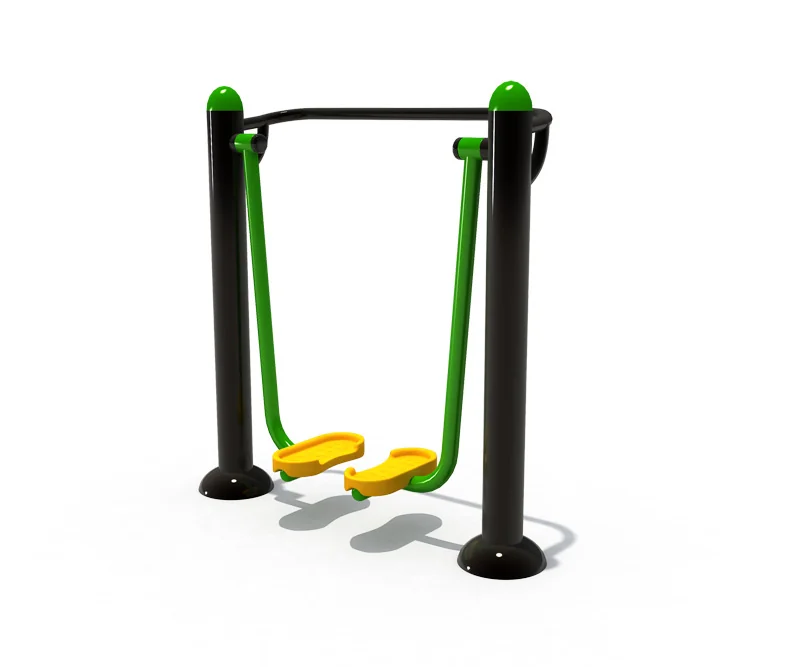
Quick answer: Buy an outdoor air walker by its documented movement, user limits, installation space and service requirements—not by its catalogue footprint alone. A public park air walker should come with a model-specific drawing, the applicable safety assessment, foundation details, operating instructions and a replacement-parts plan. Confirm these before comparing prices.
This guide focuses on the pendulum-style air walker: a stationary frame with suspended foot platforms that swing forwards and backwards. Product names vary, so ask for a movement video and drawing to distinguish an air walker from an elliptical trainer, a lateral leg stretcher or a combined station.
Start with the intended users and applicable standard
For European projects, EN 16630 addresses permanently installed, freely accessible outdoor fitness equipment. BSI describes its intended users as youths and adults, or people taller than 1,400 mm; children's playground equipment falls under a separate standards family. Specify the edition required by the project and verify its status when ordering. Source: BSI, BS EN 16630 scope.
For projects using US specifications, ASTM F3101-21a covers permanently anchored outdoor fitness equipment intended for unsupervised use by people aged 13 and older. It addresses equipment and installation, while the wider facility layout needs separate consideration. Source: ASTM F3101-21a.
Neither reference proves that a particular product has passed testing. Ask for the report identifying the supplied model, configuration, standard edition and assessed scope. Resolve any mismatch between the drawing, label and report before approving production. A general factory certificate is insufficient evidence for a specific air walker design.
Outdoor air walker specifications to compare
| Item | Ask the supplier to document | Buying decision |
|---|---|---|
| Movement | Travel direction, range, stops and demonstration video | Confirm the actual exercise motion and surrounding clearance |
| User limits | Intended age or height, permitted load and number of users | Match the station to the park's planned audience |
| Pedals and hand support | Dimensions, surface texture, edge treatment and grip layout | Review mounting, use and dismounting with the intended users |
| Moving joints | Pivot construction, guards, replaceable components and inspection access | Understand maintenance effort and wear-part replacement |
| Frame and finish | Material specification, wall thicknesses, coating process and repair instructions | Compare equivalent construction for the actual exposure |
| Installation | Overall dimensions, movement envelope, required spaces and foundation drawing | Check the complete installed area before committing the site |
| After-sales support | Parts list, warranty terms and service instructions | Establish who can restore the station to service |
Review the complete movement, not one photograph
Request views of the pedals at both ends of their travel and details around pivots, stops and adjacent members. Have the proposed design assessed for relevant trapping, crushing and impact hazards throughout movement. A smooth-looking demonstration does not establish safety under repeated public use.
Ask how the station behaves when users mount one pedal first, stop unevenly or leave it moving. These questions help the supplier explain its design and the assessor confirm the intended-use assumptions. They are not a substitute for the required testing.
Make the finish specification site-specific
Give suppliers the site location and describe coastal exposure, de-icing salts, irrigation, dust and shade. Request the proposed metal protection system in writing, including preparation, coating layers, quality checks and treatment of welds or damaged areas. Evaluate supporting corrosion evidence against that system, rather than accepting a broad “weatherproof” label.
For plastic foot platforms or covers, request the resin identification, outdoor-use evidence and cleaning guidance. Keep finish colour approval separate from mechanical approval so that an attractive sample does not close unanswered engineering questions.
Plan the installed area before placing an order
The catalogue footprint describes the equipment, not necessarily the space needed to use and maintain it. Obtain a plan showing the moving parts, required clearances, user access and any specified surfacing. Give that plan to the landscape designer alongside nearby paths, fences, trees and other stations.
The foundation drawing should identify anchoring, concrete requirements and the finished ground level. Ask the installer to check ground conditions, drainage and buried services before construction. Agree who verifies alignment, fastener settings, movement and signage during handover.
An air walker alone does not make an outdoor gym accessible to everyone. Review routes, transfer and mounting requirements, instructions and alternative exercise options as part of the full facility design.
What to include in an air walker RFQ
Send each supplier the same information so that the returned quotations can be compared line by line:
- Project country, site type, intended users and required standard edition.
- Quantity, preferred single or multiple stations, and reference photographs.
- Site plan, available area, proposed surface and known ground conditions.
- Climate exposure, finish colours and any project-specific material requirements.
- Required model drawings, test evidence, instructions and signage language.
- Supply scope: equipment, anchors, foundations, freight, installation and inspection.
- Requested delivery location and date, packing requirements and spare-parts scope.
- Warranty responsibilities, exclusions and the contact responsible for maintenance.
Separate equipment price from transport, groundworks, surfacing and installation. Then compare the complete procurement scope and likely maintenance tasks. A lower unit price may simply omit components or services included in another offer.
Frequently asked questions
Is a pendulum-style air walker the same as an elliptical trainer?
No. An air walker commonly uses suspended platforms with a swinging path, while an elliptical trainer uses a different motion mechanism. Names are inconsistent across catalogues. Compare movement videos and drawings before selecting the station.
Can children use an adult public park air walker?
Do not assume so. Confirm the assessed user group and follow the supplied instructions. Outdoor fitness and children's playground standards have different scopes; a shared location does not make an adult station suitable for younger children.
How much space does an outdoor air walker need?
There is no reliable universal dimension. Request the exact model's installation plan with its movement envelope and required clearances. Check the layout with the project designer before finalising the location.
What maintenance information should the supplier provide?
Request inspection instructions covering moving joints, stops, pedals, grips, fasteners, anchors, finishes and labels. The manual should identify inspection frequency, replacement criteria and when to take equipment out of service, adjusted to site conditions.
Request a project-specific air walker proposal
Browse HonPlay outdoor fitness equipment and the Outdoor Air Walker Station as starting references. Send HonPlay your site plan and RFQ checklist to request a configuration, documentation package and quotation for your project. Confirm the final specification and available evidence in writing before ordering.